Readings that influenced how I think
Every now and then, you read something that influences how you think, e.g. by offering a new perspective you hadn’t considered or articulating something you couldn’t quite put into words. Here are some essays, excerpts, ideas and quotes that influenced my thinking:
Paul Graham, in How To Do Great Work
What should you do if you’re young and ambitious but don’t know what to work on? What you should not do is drift along passively, assuming the problem will solve itself. You need to take action. But there is no systematic procedure you can follow. When you read biographies of people who’ve done great work, it’s remarkable how much luck is involved. They discover what to work on as a result of a chance meeting, or by reading a book they happen to pick up. So you need to make yourself a big target for luck, and the way to do that is to be curious. Try lots of things, meet lots of people, read lots of books, ask lots of questions.
When in doubt, optimize for interestingness. Fields change as you learn more about them. What mathematicians do, for example, is very different from what you do in high school math classes. So you need to give different types of work a chance to show you what they’re like. But a field should become increasingly interesting as you learn more about it. If it doesn’t, it’s probably not for you.
Paul Graham’s writings often carry nuggets of wisdom, but this one was particularly influential in shaping how I think about what to work on. I took his advice about actively trying things to heart, which led me to work in 3 different teams in the span of ~4 years at Meta. To this day, I use the framework of “optimi[zing] for interestingness” for choosing what to do.
Ben Kuhn, in Staring into the abyss as a core life skill
Staring into the abyss means thinking reasonably about things that are uncomfortable to contemplate, like arguments against your religious beliefs, or in favor of breaking up with your partner. It’s common to procrastinate on thinking hard about these things because it might require you to acknowledge that you were very wrong about something in the past, and perhaps wasted a bunch of time based on that (e.g. dating the wrong person or praying to the wrong god). However, in most cases you have to either admit this eventually or, if you never admit it, lock yourself into a sub-optimal future life trajectory, so it’s best to be impatient and stare directly into the uncomfortable topic until you’ve figured out what to do.
Staring into the abyss is an uncomfortable (but useful) exercise, because it means you need to be completely honest with yourself in assessing how things are going in your life. For various reasons, it’s easy to delude yourself into thinking that something (e.g. job, relationship, etc) is serving you well when it really isn’t.
Gena Gorlin, in Extending yourself through time
But choose with full awareness that what you’re choosing, what you’re building, is a life; your life. It’s never just “this moment,” or “this job”, or “this relationship”; it’s a point on your timeline, an inextricable part of this one precious, singular span of existence you get to design. So if you find yourself conflicted between “present you” and “future you”, the solution is not to sacrifice either one to the other; it’s to solve the underlying design problem.
Growing up, I believed that “delayed gratification” was crucial for long-term success, but I struggled with it because it felt like it came at the expense of my present happiness, like eating too many frogs. This article helped me reframe this tradeoff as a way of relating to myself through time. Understanding that it is possible to work hard in the present and learn to enjoy it while making progress at a long-term goal has allowed me to work in a more sustainable way.
Hunter S. Thompson, in a letter to his friend Hume Logan
Let’s assume that you think you have a choice of eight paths to follow (all pre-defined paths, of course). And let’s assume that you can’t see any real purpose in any of the eight. THEN— and here is the essence of all I’ve said— you MUST FIND A NINTH PATH.
Naturally, it isn’t as easy as it sounds. You’ve lived a relatively narrow life, a vertical rather than a horizontal existence. So it isn’t any too difficult to understand why you seem to feel the way you do. But a man who procrastinates in his CHOOSING will inevitably have his choice made for him by circumstance.
So if you now number yourself among the disenchanted, then you have no choice but to accept things as they are, or to seriously seek something else. But beware of looking for goals: look for a way of life. Decide how you want to live and then see what you can do to make a living WITHIN that way of life. But you say, “I don’t know where to look; I don’t know what to look for.”
And there’s the crux. Is it worth giving up what I have to look for something better? I don’t know— is it? Who can make that decision but you? But even by DECIDING TO LOOK, you go a long way toward making the choice.
I resonate with the idea that the goal should conform to the individual instead the other way round. This also frees the individual from the obligation to choose from a set of pre-defined goals; instead of deferring choice and effectively letting life happen to you, one can take responsibility in carving out a path for oneself.
Patrick McKenzie, in Don’t End The Week With Nothing
Don’t end the week with nothing. Prefer to work on things you can show. Prefer to work where people can see you. Prefer to work on things you can own.
This piece of writing influenced me to go work on Open Source Software projects at Meta (TorchRec and vLLM). In retrospect, this was a great choice which I highly recommend if you are in a position to do so.
Wolf Tivy, in Quit Your Job
Life necessarily involves these fatal leaps of faith—bets which you have no certain way of knowing will work out but which define your whole existence and require your intense effort. The squirrel has no way of knowing or checking that his instinct to bury the nuts will lead him to new life in the spring; he can only trust that God has given him what he needs. Any low-risk bet comes likewise with low returns. The highest returns of life and glory come from taking hard bets on your best visions of the future and being able to make them work through dedicated struggle.
Inspired me to take a leap of faith of my own.
Sylvia Plath, in The Unabridged Journals of Sylvia Plath
What is my life for and what am I going to do with it? I don’t know and I’m afraid. I can never read all the books I want; I can never be all the people I want and live all the lives I want. I can never train myself in all the skills I want. And what do I want? I want to live and feel all the shades, tones, and variations of mental and physical experience possible in my life.
I discovered this quote via Zhengdong’s blog (his writings are worth reading on their own merit!). I think it captures what I struggled to articulate about my general disposition towards life, which is to maximize the breadth of interesting experiences.
Richard Hamming, in You and Your Research
If you do not work on an important problem, it’s unlikely you’ll do important work. It’s perfectly obvious. Great scientists have thought through, in a careful way, a number of important problems in their field, and they keep an eye on wondering how to attack them. Let me warn you, ‘important problem’ must be phrased carefully. The three outstanding problems in physics, in a certain sense, were never worked on while I was at Bell Labs. By important I mean guaranteed a Nobel Prize and any sum of money you want to mention. We didn’t work on (1) time travel, (2) teleportation, and (3) antigravity. They are not important problems because we do not have an attack. It’s not the consequence that makes a problem important, it is that you have a reasonable attack. That is what makes a problem important. When I say that most scientists don’t work on important problems, I mean it in that sense. The average scientist, so far as I can make out, spends almost all his time working on problems which he believes will not be important and he also doesn’t believe that they will lead to important problems.
Richard Hamming is addressing scientists here, but I think it applies to anyone who takes their work seriously. I credit this one for inspiring me to dream big!
Adam Mastroianni, in Face it: you’re a crazy person
It’s no wonder that everyone struggles to figure what to do with their lives: we have not developed the cultural technology to deal with this problem because we never had to. We didn’t exactly evolve in an ancestral environment with a lot of career opportunities. And then, once we invented agriculture, almost everyone was a farmer the next 10,000 years. “What should I do with my life?” is really a post-1850 problem, which means, in the big scheme of things, we haven’t had any time to work on it.
The beginning of that work is, I believe, unpacking. As you slice open the boxes and dump out the components of your possible futures, I hope you find the job that’s crazy in the same way that you are crazy. And then I hope you go for it! Shoot for the stars! Even if you miss, you’ll still land on one of the three moons.
I think the core idea here is similar to what John Salvatier writes about in Reality Has A Surprising Amount Of Detail: any single occupation has a surprising amount of detail that is hard to reason about. Fortunately, individuals with all their quirks and idiosyncrasies are like that (slighty crazy) too. This piece made me take a more thorough/holistic approach to possible careers: what would the job actually entail? is this how I want to be spending most of my days? does it match my own craziness?
Paul Graham, in Keep Your Identity Small
Most people reading this will already be fairly tolerant. But there is a step beyond thinking of yourself as x but tolerating y: not even to consider yourself an x. The more labels you have for yourself, the dumber they make you.
Paul Graham is talking about politics and religion here but I believe the lesson can be generalized more broadly: keep your identity small and fluid, so you can easily start over and re-invent who you are instead of being tied down to a particular identity. For me, keeping my identity small also means carrying my achievements lightly so I can focus on developing qualities that will persist beyond any particular identity.
Steve Jobs, in Don’t Be A Career
Don’t be a career. The enemy of most dreams and intuitions, and one of the most dangerous and stifling concepts ever invented by humans, is the “Career.” A career is a concept for how one is supposed to progress through stages during the training for and practicing of your working life.
There are some big problems here. First and foremost is the notion that your work is different and separate from the rest of your life. If you are passionate about your life and your work, this can’t be so. They will become more or less one. This is a much better way to live one’s life.
I don’t think Steve Jobs was necessarily a role model in how to be a well-adjusted, decent person but I think he is right on point here. Obviously there are nuances to this, but I generally believe that completely immersing yourself in your work is a richer way to experience life than the alternative; the hard part is discovering work that makes it easy for you to do that, and not settling until you find one.
David Foster Wallace, in This Is Water
But most days, if you’re aware enough to give yourself a choice, you can choose to look differently at this fat, dead-eyed, over-made-up lady who just screamed at her kid in the checkout line. Maybe she’s not usually like this. Maybe she’s been up three straight nights holding the hand of a husband who is dying of bone cancer...
...
If you’re automatically sure that you know what reality is, and you are operating on your default setting, then you, like me, probably won’t consider possibilities that aren’t annoying and miserable. But if you really learn how to pay attention, then you will know there are other options. It will actually be within your power to experience a crowded, hot, slow, consumer-hell type situation as not only meaningful, but sacred, on fire with the same force that made the stars: love, fellowship, the mystical oneness of all things deep down.
Not that that mystical stuff is necessarily true. The only thing that’s capital-T True is that you get to decide how you’re gonna try to see it.
This, I submit, is the freedom of a real education, of learning how to be well-adjusted. You get to consciously decide what has meaning and what doesn’t. You get to decide what to worship.
What does it mean to be truly educated? Growing up, I wasn’t sure how to answer this. As David Foster Wallace puts it, to be educated is to wield the power to choose how you interpret your reality, and to meet it with gentle kindess towards others.
Scott Alexander, in Should You Reverse Any Advice You Hear?
I wonder whether everyone would be better off if they automatically reversed any tempting advice that they heard (except feedback directed at them personally). Whenever they read an inspirational figure saying “take more risks”, they interpret it as “I seem to be looking for advice telling me to take more risks; that fact itself means I am probably risk-seeking and need to be more careful”. Whenever they read someone telling them about the obesity crisis, they interpret it as “I seem to be in a very health-conscious community; maybe I should worry about my weight less.”
I think this is a good mental framework to have, because it forces you to think for yourself instead of blindly accepting other’s advice. For example, people are prone to giving advice that justifies their own decisions or actions. Of course, you should take Scott’s advice here with a grain of salt, too.
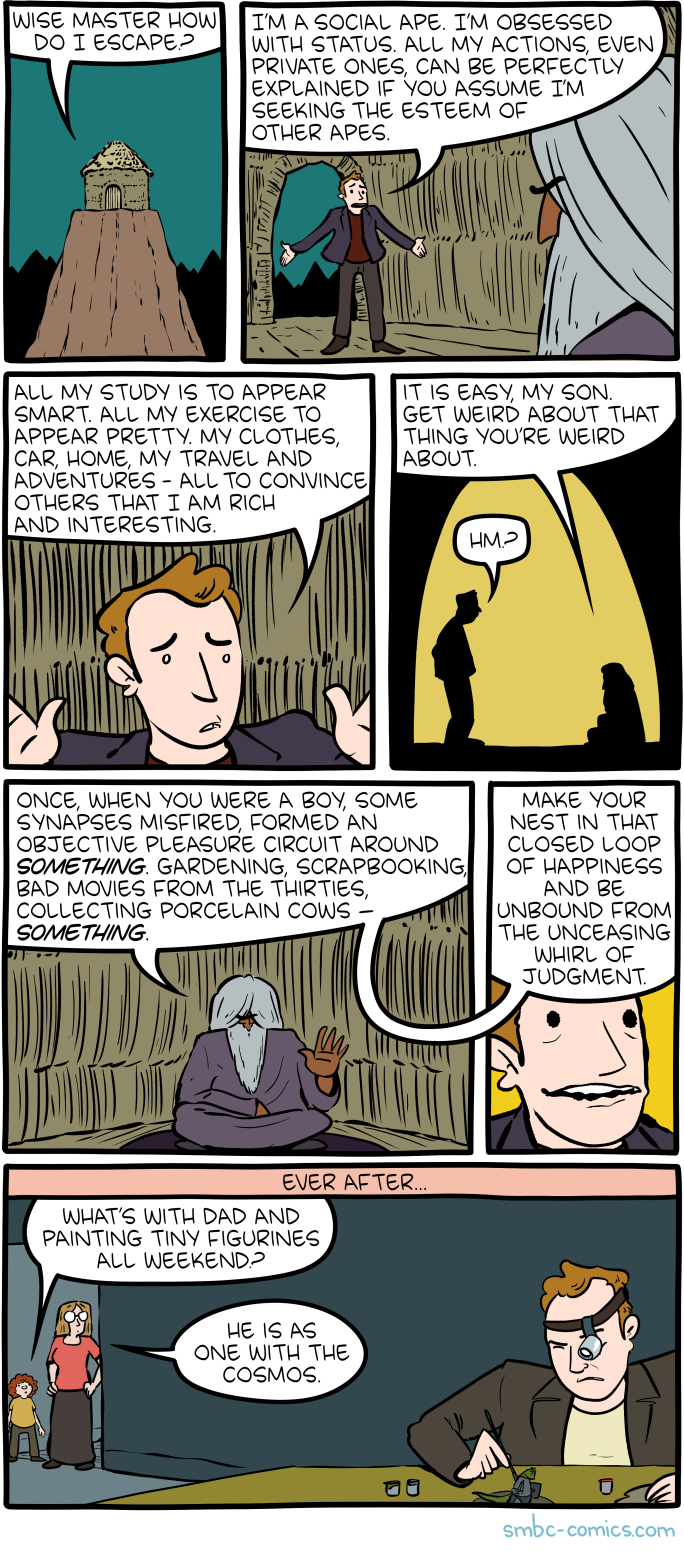
Finally: Zach Weinersmith, in Escape